— Retractable hoses
The hose stored
in its
own network.
The R-Flex turns central vacuum cleaning into a simple gesture: the hose is already there, stored in its network. You pull, you vacuum, it disappears.
— The concept
Pull, vacuum,
retract.
The retractable hose is not stored in a cupboard: it disappears into a PVC pipe specially designed for it. You pull out only the length you need from the wall box, vacuum, then the power of the central unit retracts the hose back into its network. The PVC network serves as a storage sheath.
In new construction or major renovation, the pipe can be routed around the perimeter of the rooms, within the screed. In an existing home, it can also run under the ceiling of a basement, cellar or garage to cover the living areas. For a 15 m retractable hose, approximately 15 m of PVC network is required, with about 2 m safety margin. The retractable hose integrates into a central vacuum system: see installation and indicative pricing.
— How to use
Five gestures,
and it's stored away.
Day-to-day, everything happens at the wall box: open the flap, pull out the useful length, lock the hose, vacuum, then release it and the central unit draws it back into its network. No manual coiling, no storage needed.
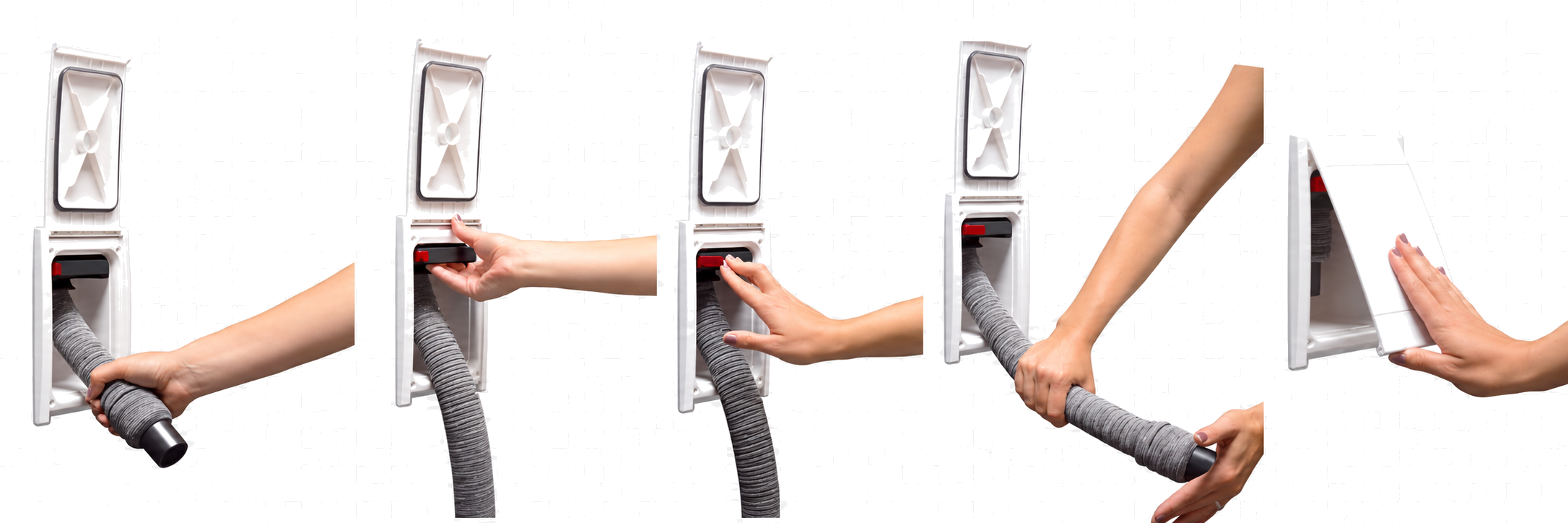
- 01Open
- 02Pull
- 03Lock
- 04Vacuum
- 05Release
— Getting started
At the wall box,
or wireless.
With a retractable hose, suction starts by default at the wall box, the moment you deploy the hose. As an option, a radio remote lets you start and stop the central unit directly from the handle, without returning to the box.
Start at the wall box
The standard operation: you open the flap, pull out the length you need and suction starts automatically as soon as the hose is locked at the box. To finish, you let the hose retract and close the flap — the central unit switches off by itself. Nothing to add, nothing to recharge.
Wireless radio remote
A radio transmitter fits on the hose handle and communicates with a receiver installed on the side of the central unit. You switch suction on and off at will, without returning to the box — handy when covering a large area.
— Components of a retractable point
What each
hose includes.
Each retractable hose comes with its installation kit: a retractable wall box, an installation kit to connect it cleanly to the network, and a bundle of PVC pipes that serves as the hose's storage sheath. The quantity simply follows the number of hoses — for a 2-hose kit, count 2 boxes, 2 installation kits and 2 PVC bundles, and so on.
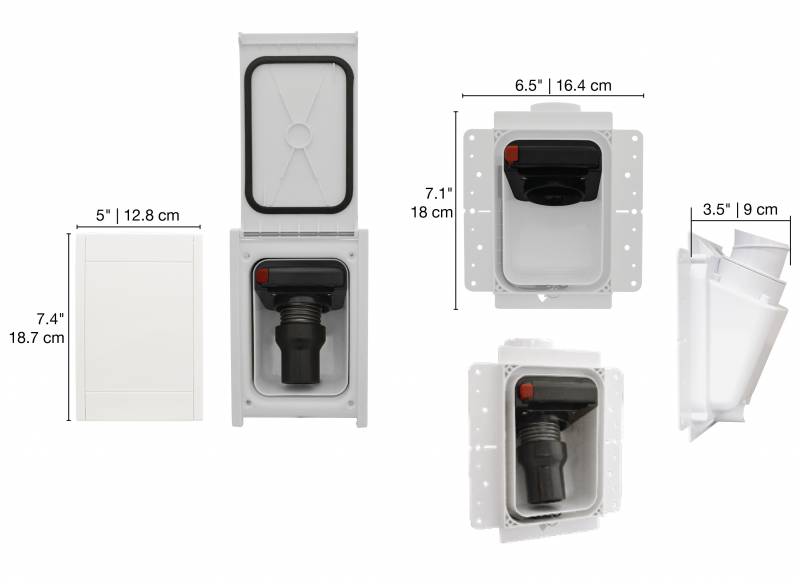
Retractable wall box
The visible inlet in the room. This is where you pull out the hose and where the central unit retracts it back into its network. Discreet, at skirting board height, one box per suction point.
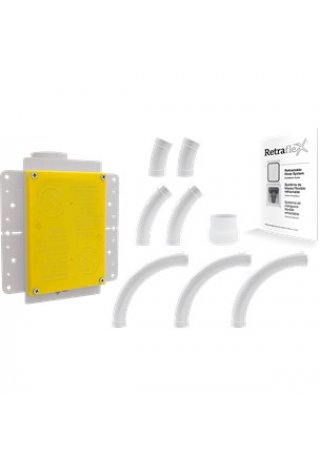
Installation kit
Mounting plate, bends, sleeve and instructions: everything needed to connect the retractable wall box to the PVC network cleanly and durably. One kit is provided per retractable hose.
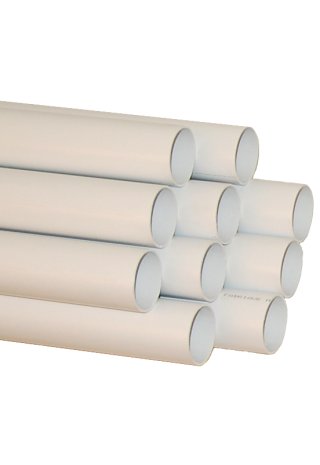
PVC network — 20 m bundle
The PVC network serves as the hose's storage sheath. A 20 m bundle is provided per retractable hose: enough to cover the hose length and the routing safety margin.
— Installation advice · Hose network
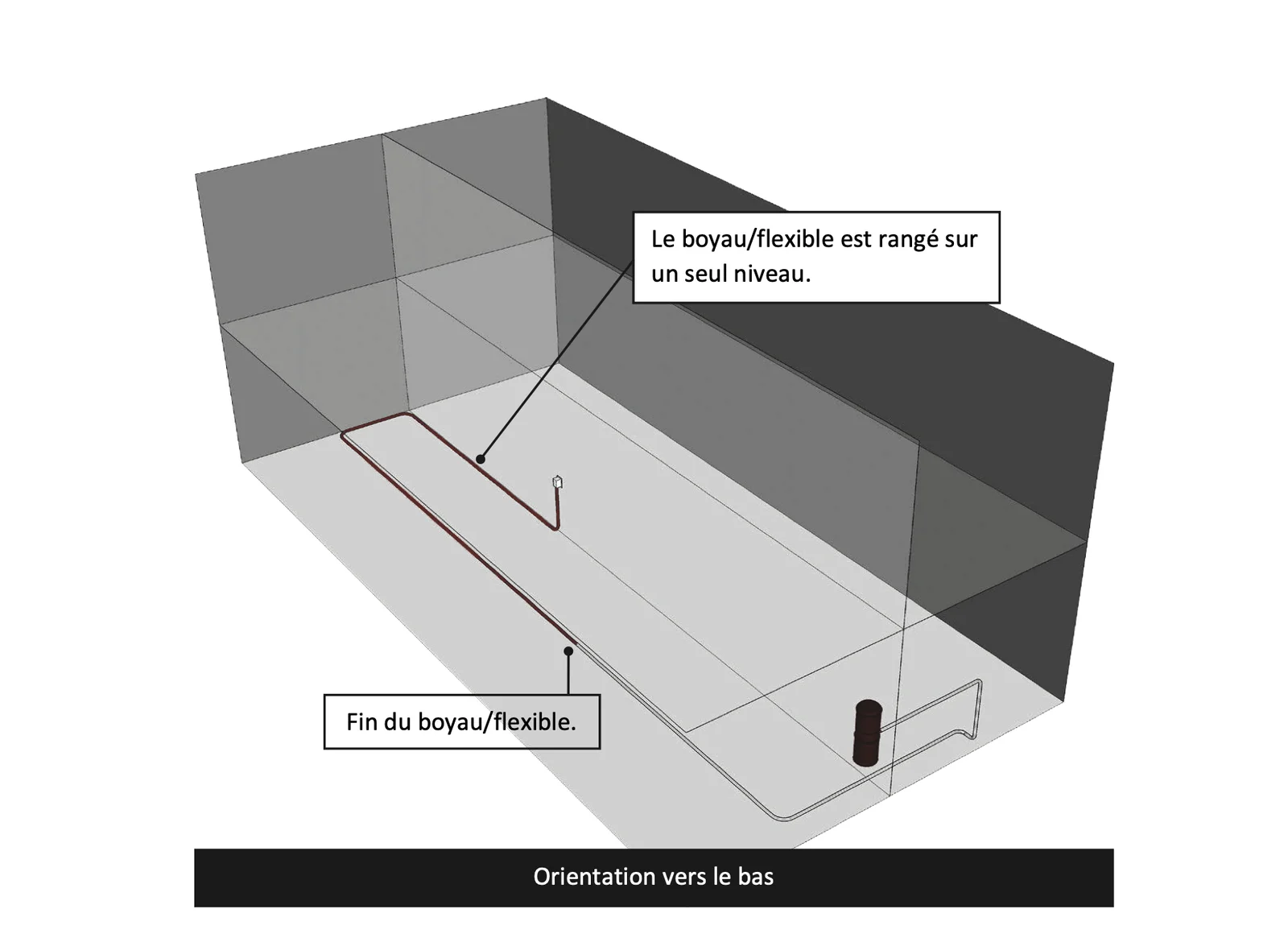
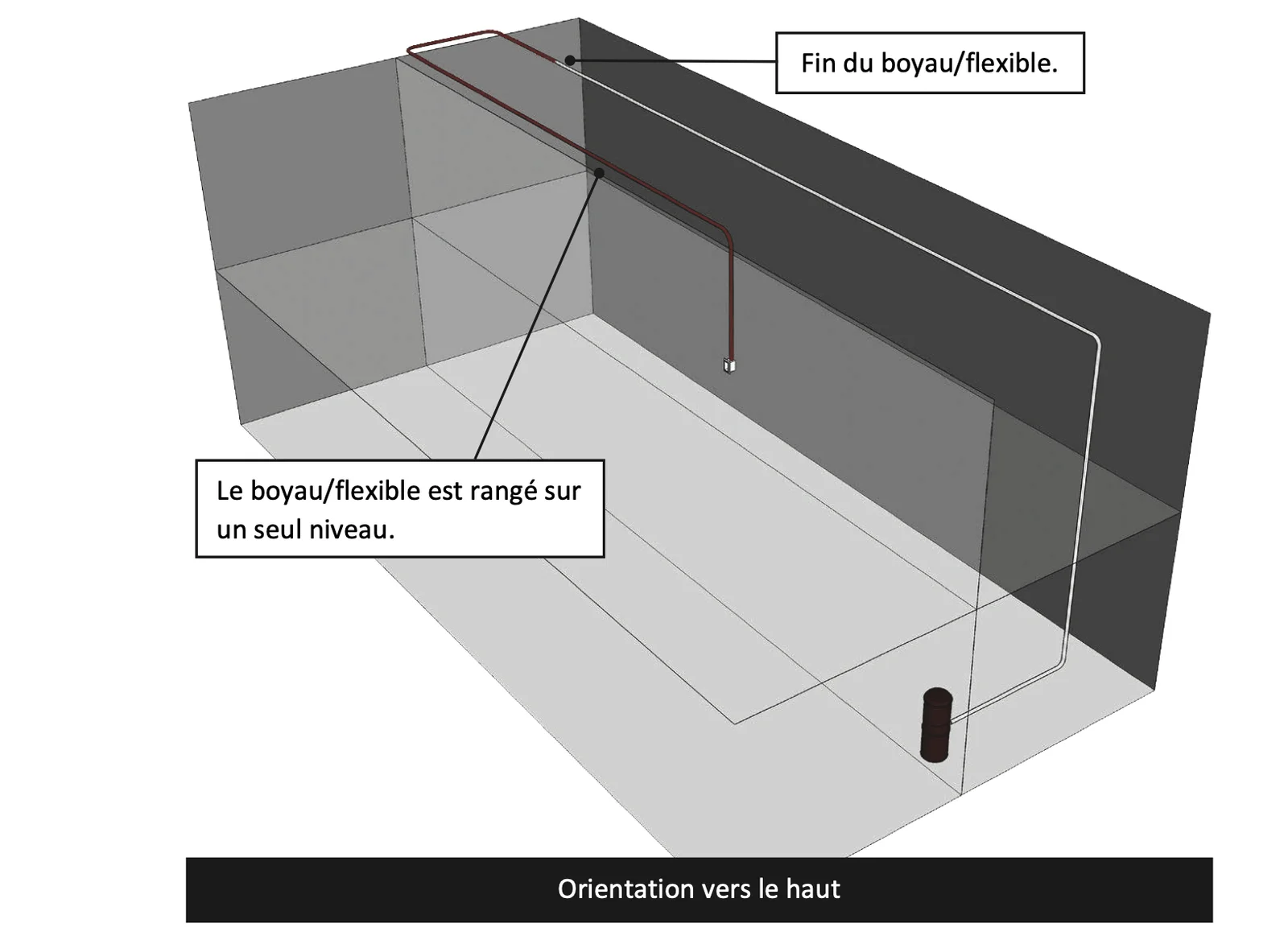
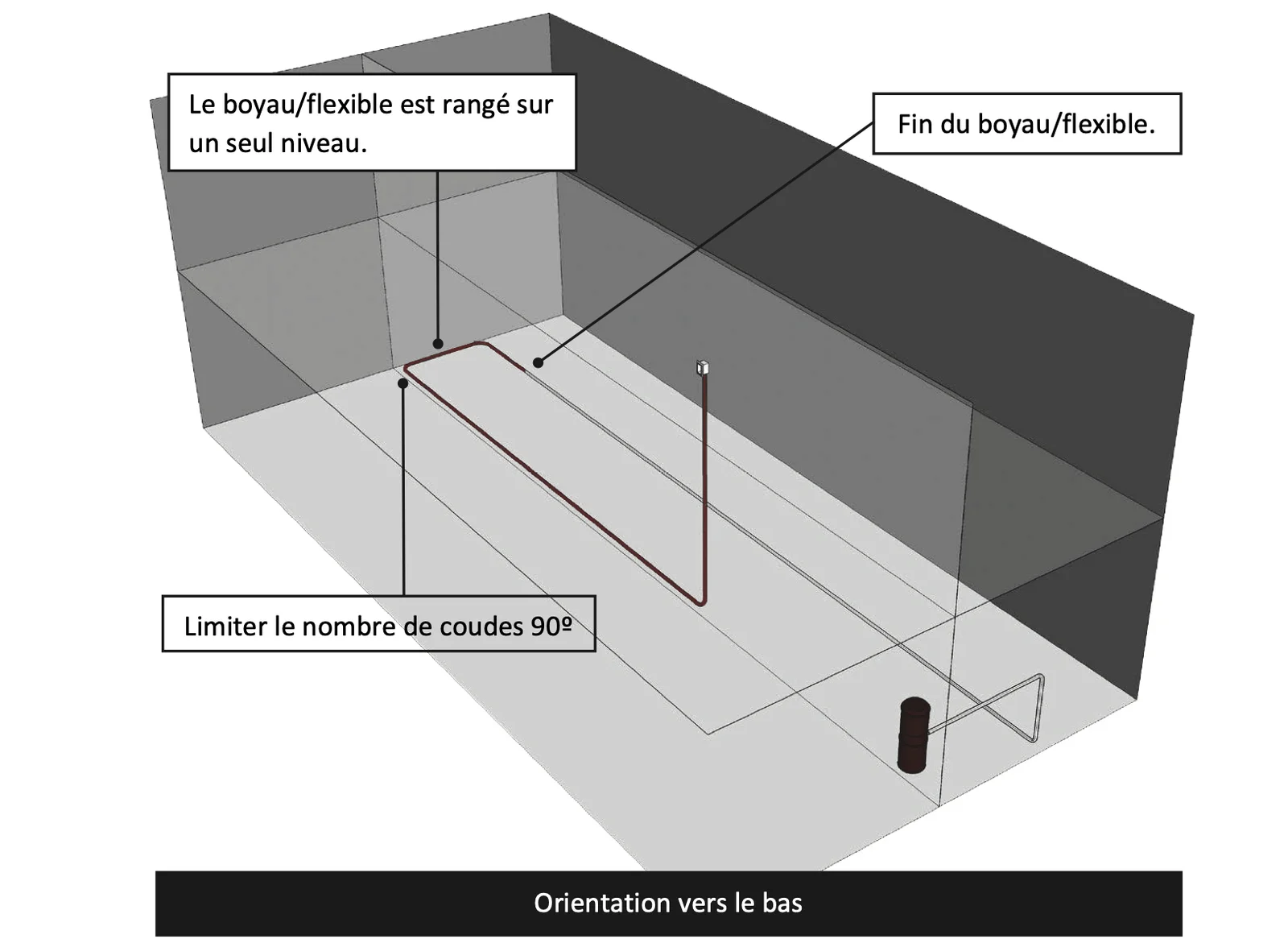
How to lay out a retractable hose network?
Good news: preparing the network for a retractable hose is well within the reach of a competent DIYer. The logic is simple — the hose first has its own storage path in the PVC, then the network runs to the central unit. Here are AspiWall's best practices for a clean, durable and smooth installation.
The PVC length follows the hose length
- 1
Allow a length of 50.8 mm antistatic rigid PVC at least equal to that of the hose. Example: for a 12 m retractable hose, allow about 12 m of PVC to store the hose.
- 2
Then add a safety margin of 1.5 m to 2 m, depending on the available space and the layout of the site.
- 3
Fit the red stop collar at the end of this storage path: for a 12 m hose, it goes at about 14 m of tube from the wall box (12 m + 2 m margin). Measuring tip: count the PVC bars (2 m each) without counting the large-radius bends — the length they add becomes additional margin.
- 4
Only after the collar does the network become a standard suction line: it joins the collector, where the lines from each retractable hose (and the home's other accessories connected to the system) come together, before running to the central unit.
A marker, and a safety stop
The red collar stops the hose exactly at the planned point. Before the collar, the PVC acts as a storage sheath for the hose; after it, it is a standard suction duct connected to the rest of the installation.
Safety — if a hose were ever to break, it remains easy to recover because it cannot travel any further into the network, beyond the collar.
AspiWall's installation best practices
Gluing the PVC
Always apply glue to the male end of the tube, never to the female end of the coupling or bend. Gluing the female part can leave a bead of glue inside when the parts are pushed together — a bead that catches dust, hair and pet hair.
Check the fit
Mark a line about 2 cm from the edge of the tube before inserting it into the coupling. This mark confirms the tube is pushed fully home, with no gap between the grooves of the fitting and the edge of the PVC — such small gaps quickly become snag points.
A clean cut
AspiWall uses a rigid pipe cutter for clean cuts, with no burrs or rough edges inside the tube. With another tool, deburr with a suitable deburring tool. Avoid sandpaper inside the tube: it creates micro-grooves that more easily retain dust, hair and pet hair.
50.8 mm antistatic PVC
It limits dust adhesion in the network and promotes a clean passage of the hose, dust, hair and pet hair, without unnecessary build-up in the ducts.
Large-radius bends only
Use only the large-radius bends specific to Retraflex retractable hoses, never small tight bends between the box and the stop collar. Per hose: typically three 90° bends, two 45° and two 22.5°. AspiWall recommends a maximum of four 90° large-radius bends — the fewer, the better.
Never bend the PVC
The PVC must never be bent or heated: every change of direction is made with a large-radius 90, 45 or 22.5° bend. The tube is laid flat and level — on the slab, in a false ceiling, etc.: no slope needs to be planned. This avoids the waves and dips that would hinder the hose from sliding and retracting.
A logical route
Generally, start from the wall holding the box, go down to the floor, then follow the perimeter of the room. A clean route with as many straight runs as possible makes the hose easier to store, reduces stress in the PVC and limits crossings with other services.
Before the other trades
Ideally, the AspiWall network is laid before the other services. Electrical, plumbing or heating conduits then pass over the PVC. Important: do not crush or oval the tube, which would hinder the hose.
The leak test
Once the network is in place, carry out a leak test — yourself by temporarily connecting the central unit, or with AspiWall on site. It confirms the network is properly sealed and the joints airtight, before closing up floors, walls and ceilings.
Planning a new build or a renovation? AspiWall can advise you on the network routing before installation — and with that support, installing it yourself stays simple.
Get advice on my routing →— Two ranges
Retraflex & R-Flex.
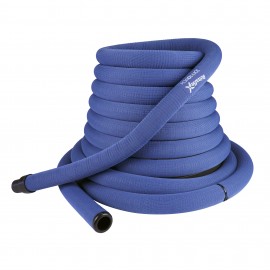
Retraflex Soft Touch
Premium solution with soft textile coating. More comfortable to hold, it limits scuffing and protects your walls and furniture during use. Designed for residential interiors where comfort and aesthetics matter as much as performance.
- Soft textile coating, comfortable to hold
- Protects walls and furniture, limits scuffing
- Premium finish, ideal for residential use
- Available in 9 m, 12 m, 15 m, 18 m
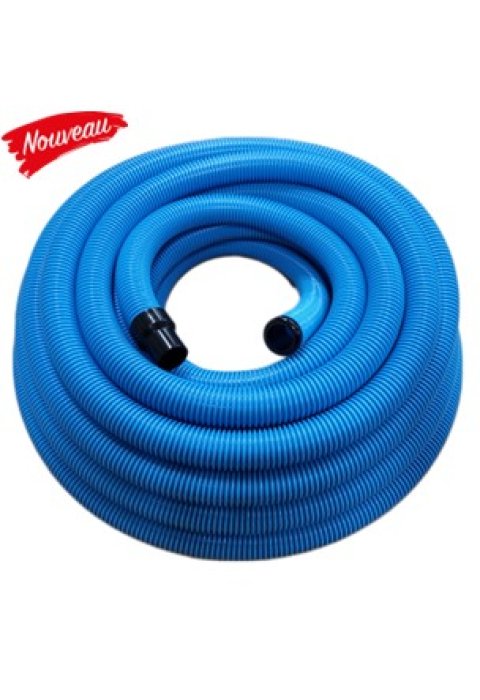
R-Flex
Simple, robust and efficient solution. No textile, easier to clean, suitable for certain professional uses where hygiene and ease of cleaning are priorities. Recommended for medical practices, hair salons, offices.
- No textile coating, easy to clean
- Robust and durable, simple maintenance
- Recommended for professional environments
- Available in 9 m, 12 m, 15 m, 18 m
— Available lengths
9, 12, 15 or 18 m.
At AspiWall, retractable hoses are available in 9 m, 12 m, 15 m and 18 m. The most popular lengths are 12 m and 15 m, constantly kept in stock, as they offer an excellent balance of comfort, reach and ease of use for most projects.
Constantly in stock at AspiWall
Constantly in stock at AspiWall
— Indicative pricing
R-Flex & Retraflex.
*Indicative prices excl. VAT, subject to change without notice.
R-Flex
- 9 m160.00 € excl. VAT*
- 12 m193.00 € excl. VAT*
- 15 m243.00 € excl. VAT*
- 18 m287.00 € excl. VAT*
Retraflex Soft Touch
- 9 m175.00 € excl. VAT*
- 12 m208.00 € excl. VAT*
- 15 m258.00 € excl. VAT*
- 18 m302.00 € excl. VAT*
Central unit + hoses,
in a single pack.
Rather than the hose alone, AspiWall offers complete packs: central unit, retractable hoses, PVC ducting and accessories included. To install yourself or have AspiWall install it — all-inclusive prices, delivery throughout Belgium.
— Traditional hoses for existing installations
Do you already have
an existing
installation?
Do you already have a central vacuum installation with standard inlets? AspiWall also supplies traditional non-retractable hoses, simply to plug into existing inlets.
This solution remains useful for older installations or for customers who want to replace a worn hose without modifying their network.
Indicative pricing
- 9 m175.00 € excl. VAT*
- 10 m185.00 € excl. VAT*
- 12 m198.00 € excl. VAT*
*Indicative prices excl. VAT, subject to change without notice.
— Retractable hoses & DIY kit
Ideal for your
guided
DIY project.
The R-Flex and Retraflex retractable hoses require careful network preparation, but they integrate very well into a guided DIY project. Preparation happens during the building work — that is the ideal time.
AspiWall helps you understand where to position the wall boxes, how to plan the lengths and how to organise the PVC network that serves as the hose sheath. With the right plan-based advice, integrating a retractable hose into new construction or major renovation is perfectly accessible as a DIY project.
What AspiWall prepares for you
- →Optimal positioning of retractable wall boxes
- →Hose length sizing
- →PVC sheath network routing
- →Choice between R-Flex and Retraflex Soft Touch
- →Integration into screed advice
- →Network check available after installation
— Installation guide
Everything you need
to install.
AspiWall provides a complete installation guide for Retraflex and R-Flex retractable hoses: the two zones of the network, heights, stop, large-radius elbows, gluing, back-boxes, 24 V wiring and commissioning. Available online step by step, with the downloadable PDF.
— Frequently asked questions
Your questions.
Our answers.
Difference between Retraflex and R-Flex?
The Retraflex Soft Touch is the premium solution: its soft textile coating is more comfortable to hold, limits scuffing and protects your walls and furniture. Ideal for residential customers looking for comfort and quality finish. The R-Flex has no textile, is simple, robust and easy to clean. It is relevant for certain professional uses (medical practices, hair salons, offices) where hygiene and ease of cleaning are priorities.
Is the hose really stored in the wall?
Yes, the retractable hose is stored in a PVC network designed specifically for it. This network acts as a storage sheath. In new construction or major renovation, this network can be placed around the perimeter of the rooms, within the screed. In an existing home, it can also run under the ceiling of a basement, cellar or garage where the configuration allows.
For example, for a 15 m hose, approximately 15 m of PVC network is required, with about 2 m safety margin. During use, you pull out the length you need from the wall box. Once finished, the power of the central unit retracts the hose back into its network.
Retractable hoses are available in 9 m, 12 m, 15 m and 18 m. The 12 m and 15 m lengths are the most popular and are constantly kept in stock at AspiWall.
Can a retractable hose be installed in a renovation?
This is possible in certain cases. In an existing home, the PVC network can sometimes run under the ceiling of a basement, cellar or garage to cover the living areas without opening all the screeds. AspiWall carries out an on-site or plan-based study to check feasibility and propose the best routing.
What lengths are available?
Retractable hoses are available in 9 m, 12 m, 15 m and 18 m. The most popular lengths are 12 m and 15 m, constantly kept in stock at AspiWall, as they offer an excellent balance of comfort, reach and ease of use for most projects.
What length of PVC should you allow for a retractable hose?
You allow a length of 50.8 mm antistatic rigid PVC equal to that of the hose, plus a safety margin of 1.5 m to 2 m depending on the space available. For example, for a 12 m hose, allow about 12 m of PVC for storage, then the margin. The red stop collar is then fitted: before it, the PVC acts as a sheath for the hose; after it, the network becomes a standard suction line running to the central unit.
Which bends are used between the wall box and the stop collar?
Only the large-radius bends specific to Retraflex retractable hoses — never small, tight bends. Per hose, you typically use three 90° bends, two 45° and two 22.5°, all large-radius. AspiWall recommends a maximum of four 90° large-radius bends on the storage section: the fewer the better, and long straight runs make the hose retract more easily.
What is the red stop collar for?
It stops the hose exactly at the planned point, at the end of its storage path. It is also a safety stop: if a hose were ever to break, it remains easy to recover because it cannot travel any further into the network, beyond the collar.
Interested in the retractable hose?
Send your plans: AspiWall advises you on the choice, lengths and network routing. You install, AspiWall guides you.